Claude Skills vs MCP: Why Skills Could Be a Bigger Deal Than the Model Context Protocol
Claude Skills vs MCP: a deep dive into why Claude Skills may prove more transformative than the Model Context Protocol. Analysis based on Simon Willison's insights on Claude Skills vs MCP.
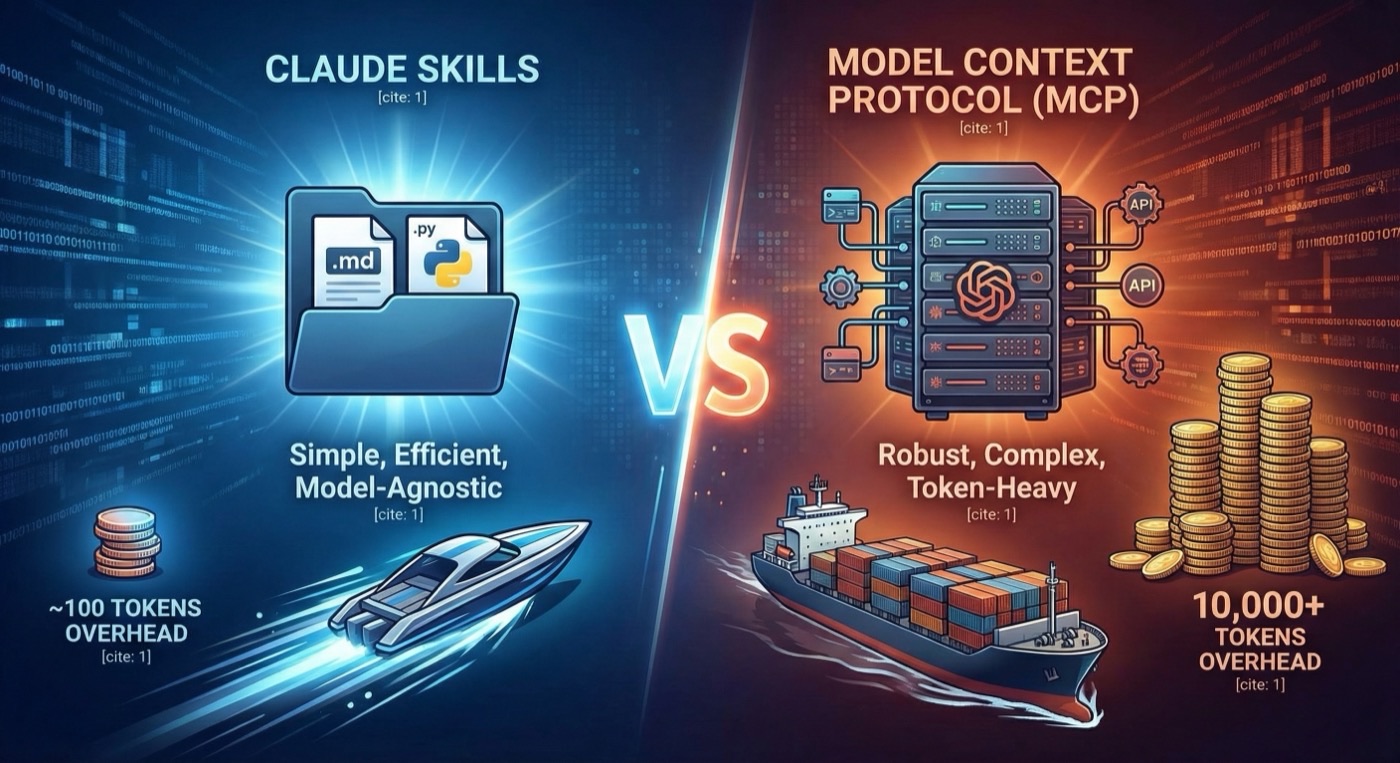
The Claude Skills vs MCP debate is heating up. When Anthropic launched Claude Skills, developer and AI commentator Simon Willison offered a striking take: in the Claude Skills vs MCP comparison, Claude Skills might end up being the bigger deal. Here's our breakdown of the Claude Skills vs MCP argument and why it matters for the ecosystem.
What Are Claude Skills, Really?
At their core, Claude Skills are remarkably straightforward. Each one is a Markdown file that tells Claude how to perform a specific task, optionally bundled with supporting documents and executable scripts. As Anthropic describes it:
Skills are folders that include instructions, scripts, and resources that Claude can load when needed. Claude will only access a skill when it's relevant to the task at hand.
What elevates Claude Skills from "just files on disk" to a proper feature is the discovery mechanism. When a session starts, Claude scans the YAML frontmatter of all installed Claude Skills, consuming only a handful of tokens per Claude Skill. The full instructions load only when a user's request matches the Claude Skill's domain — a design pattern known as progressive disclosure.
Willison points out that Claude's document creation features (PDF, DOCX, XLSX, PPTX) launched in September 2025 were actually built entirely on top of this Claude Skills architecture. The system was already proving itself at scale before the public announcement.
A Practical Example: Claude Skills in Action
To test how Claude Skills compare to MCP in practice, Willison tried Anthropic's slack-gif-creator Claude Skill — described in its metadata as a "toolkit for creating animated GIFs optimized for Slack, with validators for size constraints and composable animation primitives."
He prompted Claude to make an animated GIF comparing Claude Skills and MCPs. Claude not only generated the animation using the Claude Skill's bundled GIFBuilder library but also automatically ran a size validation function. The model leveraged the Claude Skill's included scripts without needing any manual setup.
This illustrates a key advantage in the Claude Skills vs MCP comparison: Claude Skills can ship with executable utilities that provide deterministic, reliable operations while keeping the context window clean.
The Coding Environment Connection
Claude Skills rely on Claude having access to a filesystem and the ability to run commands — a paradigm that has become standard across AI coding tools. ChatGPT's Code Interpreter pioneered this approach in 2023, and the pattern has since spread to tools like Cursor, Claude Code, Codex CLI, and Gemini CLI.
Willison notes that the power and simplicity of Claude Skills strengthens the case for making safe sandbox environments broadly available to AI models. In the Claude Skills vs MCP debate, this runtime advantage matters significantly.
Beyond Code: Claude Skills as General-Purpose Agents
One of Willison's most provocative observations is that Claude Code is poorly named. It's not just a coding assistant — it's a general-purpose computer automation tool. Anything achievable by typing terminal commands can now be orchestrated by Claude, and Claude Skills make this capability explicit and extensible.
Consider a data journalism scenario: a folder of Claude Skills could cover everything from locating US census datasets and loading them into DuckDB, to publishing results via Datasette Cloud, to building D3 visualizations. Combined, these Markdown files and a few Python scripts become a full-fledged "data journalism agent."
This vision is powerful precisely because the barrier to entry is so low. You don't need to build a complex MCP server or write an API integration — you write a Markdown file describing what you know, and Claude handles the rest.
Claude Skills vs MCP: Token Economy Matters
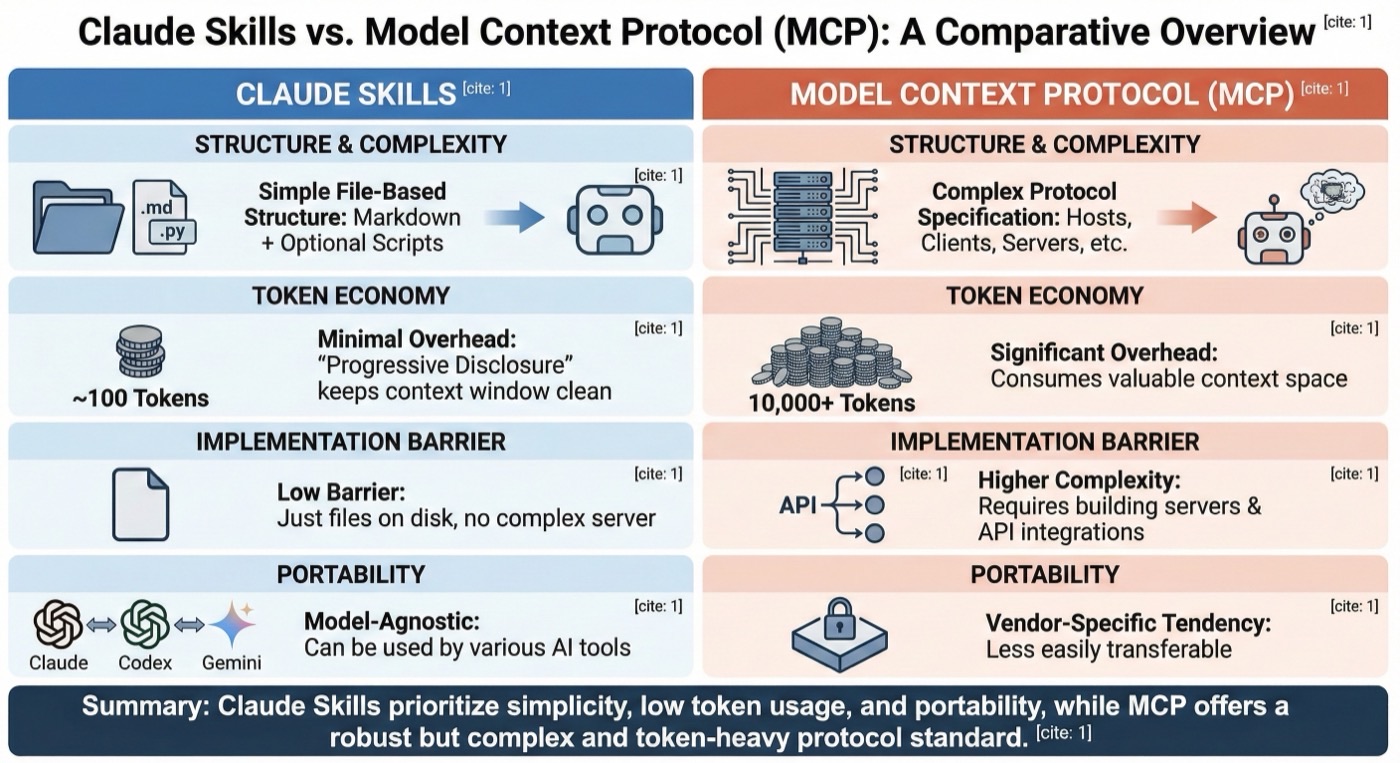
The Claude Skills vs MCP comparison becomes especially clear when examining token cost. MCP has generated significant excitement since its November 2024 debut, but Willison highlights a fundamental limitation: token overhead. GitHub's official MCP integration alone consumes tens of thousands of tokens of context, leaving limited room for the LLM to do productive work.
Claude Skills sidestep this problem entirely. Each installed Claude Skill adds roughly 100 tokens of metadata overhead. The full instructions only load when needed, and bundled scripts execute without entering the context window at all. In the Claude Skills vs MCP token economy, Claude Skills win decisively — you can have dozens of specialized capabilities ready to go without sacrificing conversational context.
As Willison puts it, almost anything achievable via MCP can be handled by a CLI tool — and LLMs already know how to run cli-tool --help. Claude Skills take this one step further: you don't even need to build a CLI tool. A Markdown file describing the workflow is often sufficient. This is the core of the Claude Skills vs MCP advantage.
Claude Skills vs MCP: Cross-Model Portability
Perhaps the most underappreciated aspect of Claude Skills in the Claude Skills vs MCP comparison is their model-agnostic nature. Since Claude Skills are just files on disk with standard Markdown instructions, nothing prevents other AI models from using them. Willison tested this directly: you can point Codex CLI or Gemini CLI at a Claude Skills folder and it works.
This portability gives Claude Skills another edge over MCP. A Claude Skill created for Claude Code works equally well with competing tools, removing vendor lock-in concerns and encouraging a shared ecosystem.
Claude Skills vs MCP: Why Simplicity Wins
Some critics have dismissed Claude Skills as too simple compared to MCP. After all, developers have long used patterns like AGENTS.md to drop custom instructions into project directories.
But Willison argues this simplicity is precisely why Claude Skills beat MCP for most use cases. Compare the two approaches:
- MCP requires implementing a full protocol specification covering hosts, clients, servers, resources, prompts, tools, sampling, roots, elicitation, and multiple transport layers (stdio, streamable HTTP, SSE).
- Claude Skills are Markdown files with a dash of YAML metadata and optional scripts in any language the environment supports.
Claude Skills align more naturally with how LLMs work: throw in well-structured text and let the model figure out what to do. In the Claude Skills vs MCP design philosophy, Claude Skills delegate the complexity to the runtime environment — a pragmatic and effective strategy.
Willison expects a "Cambrian explosion" of Claude Skills that will dwarf the MCP adoption wave. Given the near-zero cost of creating and sharing a Claude Skill, that prediction seems well-founded.
This article draws on Simon Willison's original analysis. We encourage you to read his full post for additional context and examples.